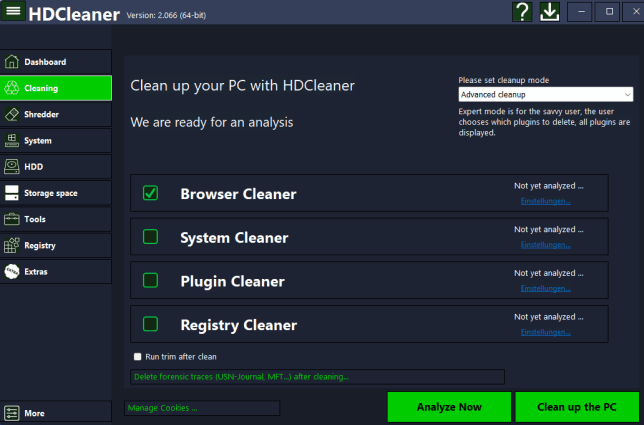
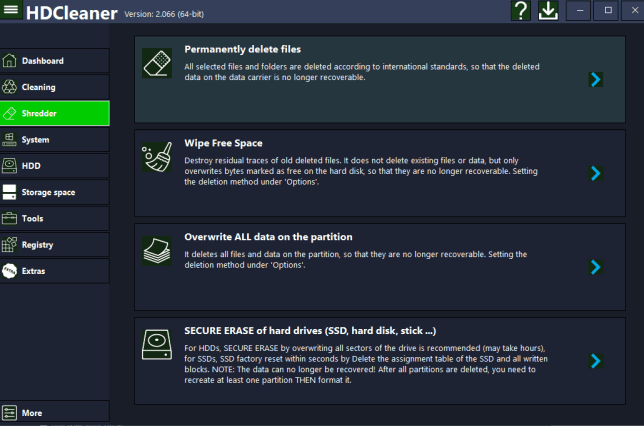
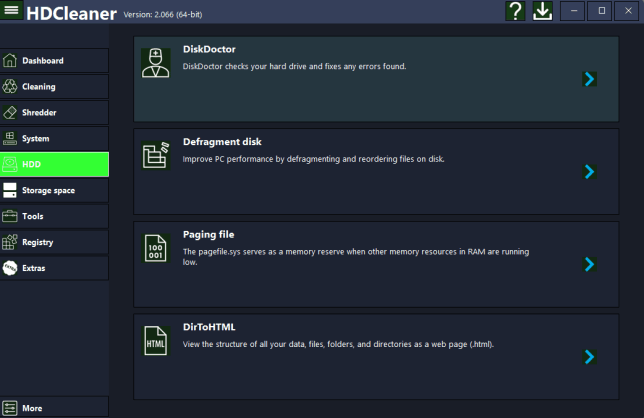
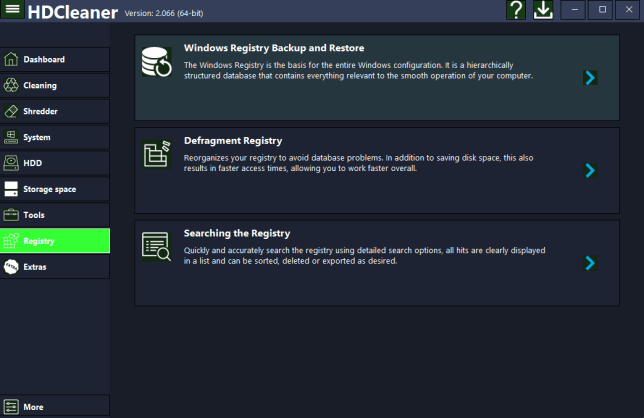
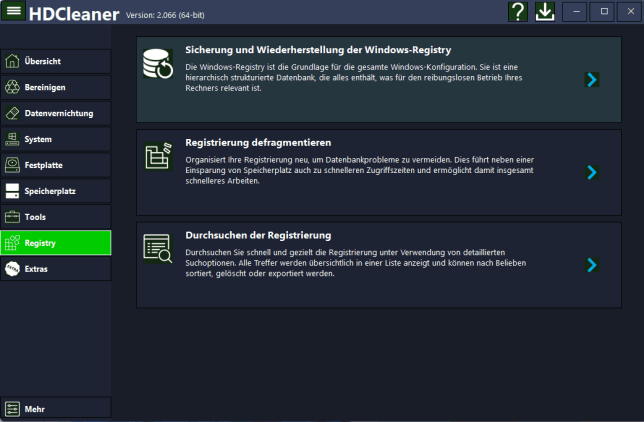
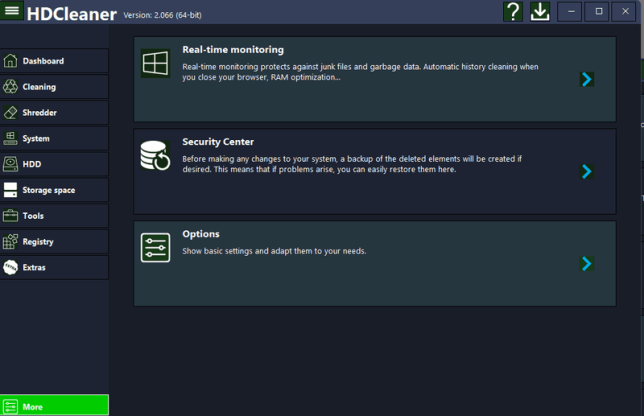
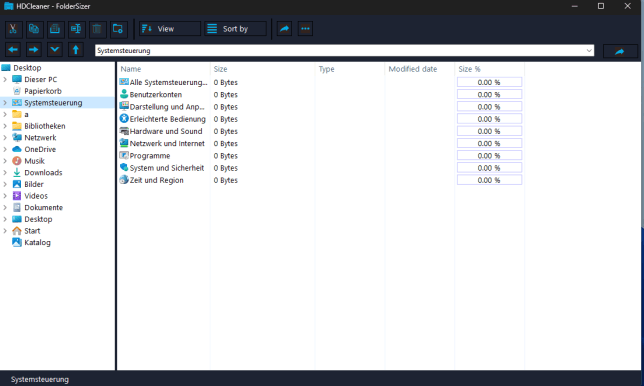
HDCleaner offers a comprehensive suite of programs for Windows system maintenance. Whether you want to declutter your hard drive, clean the registry, encrypt data, remove user traces, completely back up the registry, defragment it, or perform a quick scan – you'll always find the right tool in the clearly arranged "toolbox." With one-click optimization, the application organizes and cleans the registry, destroys internet traces, removes temporary files, defragments the registry, finds hard drive errors, and optimizes system startup. Optimized for use with solid-state drives (SSD) and hard disk drives (HDD).
With over 5,500 cleaning and repair functions, HDCleaner reduces junk files to a minimum, freeing up more system resources for Windows, using less memory, and running error-free, resulting in better PC performance.
HDCleaner lets you add any program on your system to have its data cleaned.
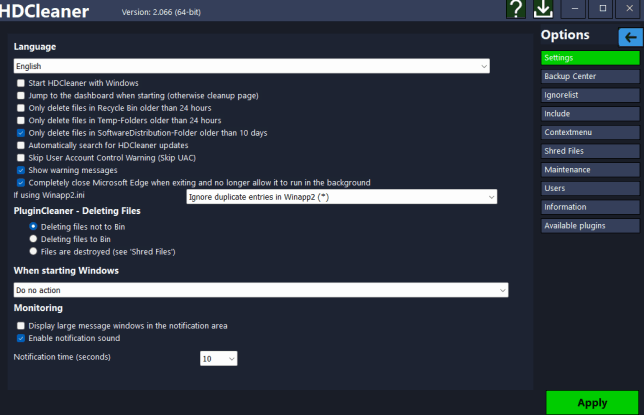
Supports Winapp2.ini.
Optimized for use with solid-state drives (SSD) and hard disk drives (HDD).
HDCleaner supports three cleaning modes:
Simple Cleanup - HDCleaner automatically scans for internet traces and junk files, which can be easily deleted. No user settings are required.
Standard Cleanup - This option is for standard users. The user determines which plugins should be deleted. Only the most commonly used plugins are displayed.
Advanced Cleanup - Expert mode is designed for experienced users. The user determines which plugins should be deleted. All plugins are displayed.
Prevent unnecessary programs from starting when your computer boots up. When you start your computer, more than just Windows loads. All of these automatically opening programs consume system memory and can slow down performance. Fortunately, managing startup programs isn't difficult with HDCleaner.
Uninstall programs you don't use; they only slow down your computer. This frees up disk space and saves resources. All associated files, settings, and registry entries will also be removed.
Quickly name channels (Alpha Tags) instead of scrolling through menus.
Master Guide to Zastone D9000 Programming Software The is a powerhouse in the world of mobile ham radios, known for its massive 50W output, dual-band capabilities, and distinctive detachable faceplate. However, to truly unlock its potential, you need to move beyond manual front-panel programming.
This is the "gold standard" for open-source radio programming. Check the latest CHIRP builds to see if the D9000 is supported under the "Zastone" or "TYT" (as many share internal boards) categories. Step-by-Step Programming Guide 1. Driver Installation
Ensure your cable uses a reliable chipset (like FTDI ). Cheaper cables often use counterfeit Prolific chips that require older, specific drivers to work on Windows 10 or 11. Where to Download the Zastone D9000 Software
Once your list is complete, click Do not unplug the cable or turn off the radio until the progress bar reaches 100%. The radio will usually reboot automatically once the data is uploaded. Troubleshooting Common Issues
Using the is the most efficient way to manage hundreds of channels, set up repeaters, and configure advanced features like CTCSS/DCS tones. Here is everything you need to know to get your rig running perfectly. Why Use the Programming Software?
Toggle specific settings like APO (Auto Power Off), squelch levels, and cooling fan behavior more intuitively. Getting Started: Hardware Requirements
Keep a saved on your computer. If you take a road trip, you can create a separate file for the frequencies in that specific region and swap them out in seconds before you leave.
While the D9000 allows for manual entry, the software offers several "quality of life" advantages:
Choose between Low, Medium, or High (50W) power levels per channel. 4. Writing to the Radio
Quickly name channels (Alpha Tags) instead of scrolling through menus.
Master Guide to Zastone D9000 Programming Software The is a powerhouse in the world of mobile ham radios, known for its massive 50W output, dual-band capabilities, and distinctive detachable faceplate. However, to truly unlock its potential, you need to move beyond manual front-panel programming.
This is the "gold standard" for open-source radio programming. Check the latest CHIRP builds to see if the D9000 is supported under the "Zastone" or "TYT" (as many share internal boards) categories. Step-by-Step Programming Guide 1. Driver Installation zastone d9000 programming software
Ensure your cable uses a reliable chipset (like FTDI ). Cheaper cables often use counterfeit Prolific chips that require older, specific drivers to work on Windows 10 or 11. Where to Download the Zastone D9000 Software
Once your list is complete, click Do not unplug the cable or turn off the radio until the progress bar reaches 100%. The radio will usually reboot automatically once the data is uploaded. Troubleshooting Common Issues Quickly name channels (Alpha Tags) instead of scrolling
Using the is the most efficient way to manage hundreds of channels, set up repeaters, and configure advanced features like CTCSS/DCS tones. Here is everything you need to know to get your rig running perfectly. Why Use the Programming Software?
Toggle specific settings like APO (Auto Power Off), squelch levels, and cooling fan behavior more intuitively. Getting Started: Hardware Requirements This is the "gold standard" for open-source radio
Keep a saved on your computer. If you take a road trip, you can create a separate file for the frequencies in that specific region and swap them out in seconds before you leave.
While the D9000 allows for manual entry, the software offers several "quality of life" advantages:
Choose between Low, Medium, or High (50W) power levels per channel. 4. Writing to the Radio