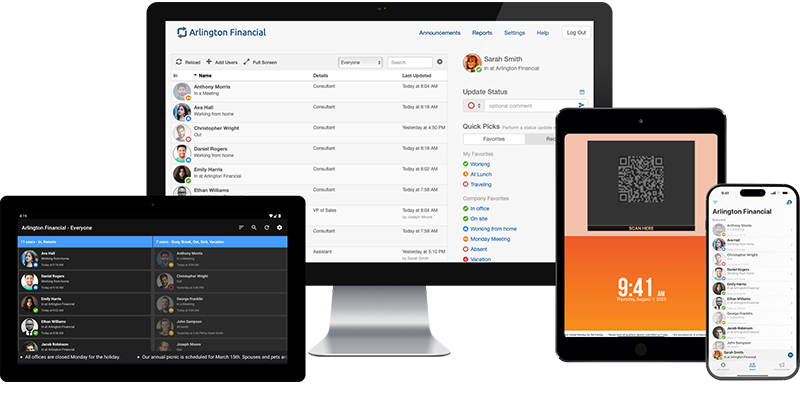


Our mission is to have the most accurate in/out board ever created. To accomplish this, Simple In/Out can automatically update your status by carrying your phone in and out of the office. We also support updates based on your computer activity.
No matter how you use Simple In/Out, you'll have an unprecedented level of visibility into your organization. View all employee statuses on your phone, computer, television, and more. We include email addresses and phone numbers for a great portable company directory. Using Notifications, Simple In/Out can keep you informed of your workforce's activity as it happens.
Replace your punch clock, time cards, and calculator with a modern approach that saves you time and includes all the benefits of Simple In/Out. Utilizing our app TimeClock and a device in a common area, your users can check in and out with a simple scan of their employee badge.
Reducing latency by pushing static content closer to the user. Is the "Alex Wu" PDF worth it?
Many candidates search for terms like hoping to find free resources, summaries, or repositories to aid their study. Here is everything you need to know about why this resource is vital and how to use it effectively. Why Alex Xu’s Guide is the Industry Standard
Finding the PDF or GitHub repo is only the first step. To pass the interview: Use platforms like Pramp or Exponent.
System design evolves. Modern interviews now frequently include "Design a Web Crawler" or "Design a Notification System" with a focus on real-time protocols like WebSockets.
How to split data across multiple servers when a single instance hits its limit.
Focus on specific bottlenecks (Consistency models, partitioning, cache eviction). Wrap Up: Discuss error handling and future scalability. Searching GitHub for System Design Resources
If you are looking for "Alex Wu" style content on GitHub, look for repositories that cover these classic problems:
Draw the basic components (Load balancers, API gateways, Databases).
Define features, scale (DAU), and constraints.
Designing Snowflake-like IDs at scale.
