

[Click here for a key to the symbols used. Some county routes were constructed with federal funds. These routes are indicated as FAP (Federal Aid Primary), FAU (Federal Aid Urban), or FAS (Federal Aid Secondary). If no funding source is shown, no federal funds were used. Note that while some segments seem to have the same attributes, they may differ in the county-local road number assigned to the segment, or in the Caltrans Map Sheet number.]
 Routing
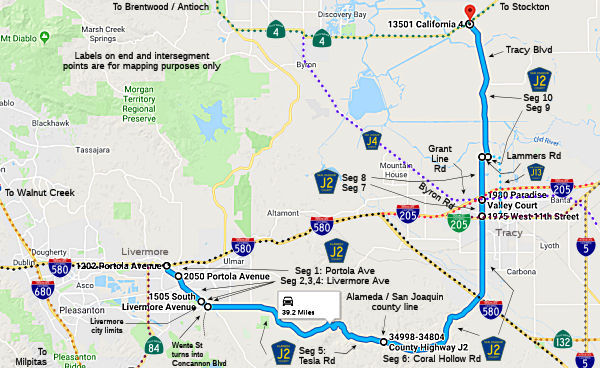 Portola Avenue from I-580 to the Livermore city limits (FAU, 0.72 mi) [Alameda County]
Livermore Avenue in Livermore (FAU, 1.25 mi) [Alameda County]
S Livermore Avnue from the Livermore city limits to Wente Street
Concannon Blvd (FAU, 0.75 mi) [Alameda County]
S Livermore Avenue from Wente Street Concannon Blvd
to Tesla Road (FAS, 0.54 mi) [Alameda County]
Tesla Road from S Livermore Avenue to the San Joaquin county line (FAS, 12.21 mi) [Alameda County]
Corral Hollow Road from the Alameda county line to Byron Road (FAS, 12.05 mi) [San Joaquin County]
Corral Hollow Road from Byron Road to Grant Line Road (County Sign Route J4) (FAU, 0.85 mi) [San Joaquin County]
Corral Hollow Road from Grant Line Road (County Sign Route J4) to Lammers Road (FAS, 2.65 mi) [San Joaquin County]
Lammers Road from Corral Hollow Road to Tracy Blvd (FAS, 0.30 mi) [San Joaquin County]
Tracy Blvd from Lammers Road to Route 4 (FAS, 7.90 mi) [San Joaquin County]
 History and Signage Information
When installing Arial Normal Version 7.00, it is vital to check for existing duplicates. System conflicts often arise when multiple versions of the same font family are present in the Windows Fonts folder or the macOS Font Book.
By using a specific repack, users can guarantee that every workstation renders documents, web interfaces, and UI elements identically. This is critical for legal documents and corporate branding where a shift in line height or character spacing—common in older versions—could disrupt the layout. Key Advantages of Arial Normal 7.00 When installing Arial Normal Version 7
Developed in 1982 by Robin Nicholas and Patricia Saunders for Monotype, Arial was designed to be a versatile sans-serif typeface. While it is frequently compared to Helvetica, Arial features more rounded curves and softer terminals, making it exceptionally readable on low-resolution screens. Version 7.00 marks a significant milestone in the font’s evolution, incorporating advanced hinting and expanded glyph support. Technical Specifications of Version 7.00 This is critical for legal documents and corporate
The font Arial Normal, specifically OpenType TrueType Version 7.00 for Western character sets, remains a foundational element of digital typography. This particular iteration, often found in various system repacks, represents decades of refinement in legibility and cross-platform compatibility. Version 7
Full support for English, Spanish, French, and German. Implementation and Usage
Version 7.00 of Arial Normal utilizes the OpenType format with a TrueType outline (OTF-TT). This hybrid nature allows it to benefit from the sophisticated layout features of OpenType while maintaining the robust performance and grid-fitting capabilities of TrueType. OpenType TrueType (.ttf) Version: 7.00 Design Style: Sans Serif, Normal weight Character Set: Western (Latin 1) Hinting: Enhanced for high-DPI displays Compatibility: Windows, macOS, Linux, and mobile OS The Western Repack Context
For web developers, Arial is the ultimate fallback font. Even if a custom brand font fails to load via CSS, specifying "Arial, sans-serif" ensures that the user still sees a clean, professional interface. Version 7.00 specifically offers better rendering in modern browsers like Chrome and Edge compared to the 5.xx versions found in legacy systems.
 National Trails
 This route is part of the De Anza National Historic Trail.
 Other WWW Links
 Status
Total mileage: 39.22 mi.
© 1996-2024 Daniel P. Faigin.
Maintained by: Daniel P. Faigin
<>.
 CR J1
CR J1 CR J3
CR J3