Overtone
Feel The Flash Hardcore - Kasumi May 2026
: Most modern users access the game via emulators like Ruffle or stand-alone Flash players that bypass browser security blocks.
: The core gameplay involves interacting with the character through mouse movements, clicking, and dragging to trigger various reactions.
refers to a legacy interactive Flash-based simulation game, most notably known as Kasumi Rebirth , featuring the character Kasumi from the Dead or Alive series. Originally released in 2004 and maintained for over a decade, it became a cult classic in the niche "interactive simulation" genre before official support ended in 2016. Overview and Gameplay Mechanics Feel The Flash Hardcore - Kasumi
: Although the developer officially ended support and moved to other projects on Patreon , the game's files continue to circulate on archive sites and community forums.
: Players can often change costumes or settings, with the game featuring dual voice acting in both Japanese and English (or "Engrish"). Cultural Impact and Legacy : Most modern users access the game via
Since Adobe Flash Player was officially discontinued, running the game today requires specialized software.
For many, the game represents a specific era of the early-to-mid 2000s internet where Flash games pushed the boundaries of interactivity. Originally released in 2004 and maintained for over
The title is celebrated for its surprisingly fluid animation and interactive depth despite being built on the now-deprecated Flash platform.
: The game is frequently found on community repositories like Spaces.ru or other 2D game archives.
: It is frequently cited alongside other "rebirth" style games as a benchmark for the genre, focusing on high-quality 2D art and responsive AI-like behavior. Current Availability
Examples
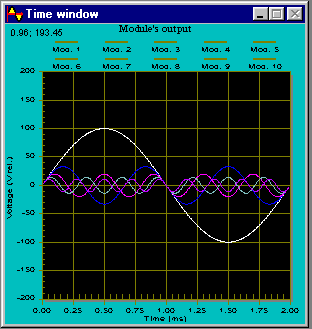
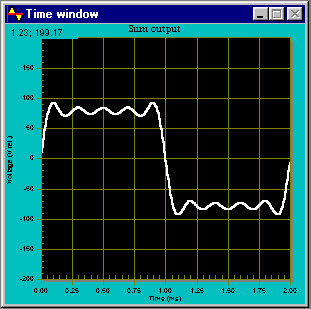
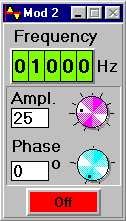
You can test the Helmholtz assumption that the relative phases of the overtones are irrelevant to hearing.
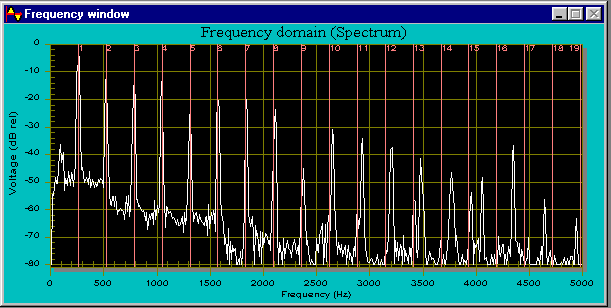
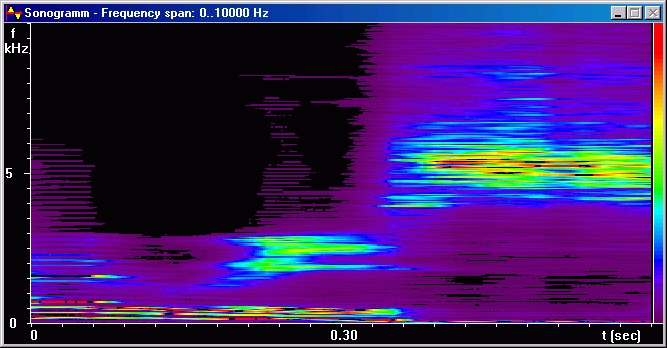
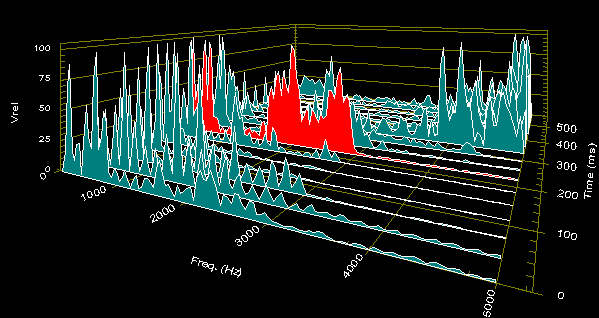
In analyser experiments you capture sound from the sound card or from a WAV file up to several seconds long, select the starting time of the time slice and analyse time and frequency responses. The example shows the spectrum of a piano playing a middle C (262 Hz). The non-harmonic overtones are clearly seen. (Due to the stiffness of the string, the frequencies of the partials are too high.)
Download version 1.15, June 2009: OVERTONE.ZIP
(1.55 MB)
Unpack in a new folder, read README.TXT and start OVERTONE.EXE
(Some firewalls or User Access Control (UAC) may block execution. Give OVERTONE the necessary permissions.
Make sure, that the sound device is not used by another application.)
For more information, send e-mail to address given in README.TXT
Unterrichtseinheit Analyse von Klangspektren von Alain Hauser (in German)
